How Does an Outdoor Kitchen Sink Work?
The Outdoor Sink Plumbing Problem Nobody Warns You About

You’ve designed the perfect outdoor kitchen. You’ve chosen your grill, picked out countertops, selected the ideal sink. Then reality hits: how do you actually get water to a sink that’s 30 feet from your house?
Most homeowners discover this challenge too late in the process. By the time you’re ready to install that beautiful stainless steel sink, you’re facing quotes of $2,000 to $5,000 to run traditional plumbing lines through your yard. Suddenly, your budget-friendly outdoor kitchen project isn’t looking so affordable.
Here’s what the professionals don’t always tell you upfront: traditional underground plumbing isn’t your only option. In fact, depending on how you use your outdoor kitchen, it might not even be the best option.
The real question isn’t whether you need an outdoor sink—if you’re serious about outdoor cooking and entertaining, you absolutely do. The question is which water supply and drainage method matches your cooking style, climate, and budget.
Understanding How Outdoor Kitchen Sinks Work
An outdoor kitchen sink operates on the same basic principle as your indoor kitchen sink: it needs a water supply coming in and a drainage system going out. But unlike indoor plumbing, which connects to water lines and sewer systems hidden inside your walls, outdoor sinks give you flexibility to choose from multiple supply and drainage configurations.
The four components you’ll need to address:
- Cold water supply (essential for any outdoor sink)
- Hot water supply (optional but highly recommended for serious cooks)
- Drainage system (where the water goes after it leaves the sink)
- Winterization plan (critical in freezing climates)
Your choices for each component directly impact your installation cost, ongoing maintenance, and how useful the sink actually is for outdoor entertaining.
Problem #1: Your Outdoor Kitchen Is Far from the House (20+ Feet)
The Challenge: Running underground water lines across your yard requires trenching, permits, and professional installation. You’re looking at $2,000-$5,000 minimum, assuming you don’t hit any obstacles like tree roots, irrigation lines, or existing hardscape.
Solution: Garden Hose Water Supply
The simplest and most budget-friendly option is connecting your outdoor sink to an existing outdoor spigot using a garden hose or PEX water line.
How it works:
- Run a standard garden hose or PEX tubing from your outdoor hose bib to your sink cabinet
- Use adapter fittings to connect the hose to your sink faucet
- Conceal the hose by running it through plantings, under mulch, or inside the base of your outdoor kitchen island
- Install a shutoff valve inside the sink cabinet for easy winterization
What you’ll need:
- Garden hose or 1/2″ PEX tubing (length depends on distance)
- Hose-to-faucet adapter fittings
- Mounting clamps
- Shutoff valve
- Basic tools (wrench, drill)
Real cost: $50-$200 depending on distance and materials
Best for:
- Seasonal outdoor kitchens (spring through fall use)
- Light to moderate cooking and entertaining
- Cold water–only needs (rinsing vegetables, washing hands, filling pots)
- DIY-friendly installations
Limitations:
- Cold water only
- May have lower water pressure than indoor plumbing
- Hose must be drained and stored for winter in freezing climates
- Visible hose routing requires creative concealment
YouTube Tutorial: [Search for and embed: “outdoor kitchen sink garden hose connection” or similar high-quality installation video]
Upgrade: Add Hot Water with a Tankless Heater
If you need hot water for washing dishes and cookware, add a point-of-use tankless water heater inside your sink cabinet.
How it works:
- Garden hose supplies cold water to both the cold side of your faucet AND to a small electric tankless water heater
- Water heater connects to the hot side of your faucet
- Heater only runs when you turn on hot water
Additional cost: $250-$600 for the heater plus $100-$200 for electrical work (requires 110V outlet with 20-amp circuit)
Total investment: $400-$1,000 for complete hot and cold water system
Best tankless options for outdoor sinks:
- Ecosmart ECO Mini (2.5 GPM, ideal for sink use)
- Stiebel Eltron Mini (compact, fits in most sink cabinets)
- Bosch Tronic 3000 (reliable, good warranty)
YouTube Tutorial: [Search for and embed: “install tankless water heater outdoor sink” or similar]
This setup gives you full hot and cold water functionality for a fraction of the cost of running underground lines, and it’s completely reversible if you move or redesign your outdoor space.
Problem #2: Your Outdoor Kitchen Backs Up to an Indoor Bathroom or Kitchen
The Challenge: You want the convenience of full hot and cold running water without the limitations of a garden hose system. Your outdoor kitchen is located near an exterior wall that happens to have indoor plumbing on the other side.
Solution: Tap Into Existing Indoor Supply Lines
When your outdoor sink is within 10-15 feet of existing indoor plumbing, connecting directly to your home’s water supply becomes cost-effective and delivers the same water pressure and temperature control you’d get indoors.
How it works:
- A licensed plumber opens the exterior wall near existing bathroom or kitchen plumbing
- Hot and cold supply lines are tapped with T-fittings
- New lines run through the wall to your outdoor sink location
- Shutoff valves are installed for winterization
What’s involved:
- Opening and repairing exterior wall
- Installing T-fittings on existing supply lines
- Running new supply lines (copper or PEX)
- Adding shutoff valves and insulation
- Obtaining plumbing permit (required in most areas)
Real cost: $800-$2,500 depending on wall access and local labor rates
Best for:
- Year-round outdoor kitchen use
- Outdoor kitchens attached to or very near the house
- Homeowners who want full indoor-quality water pressure and temperature
- Situations where resale value matters (permanent plumbing adds value)
Permit requirements: Most municipalities require a plumbing permit when tapping into domestic water supply lines. Your plumber will handle this, but budget for:
- Permit fees: $50-$200
- Inspection requirements
- Code compliance (backflow prevention, proper venting)
Critical winterization note: In freezing climates, exterior supply lines MUST have:
- Shutoff valves inside the heated house
- Drain valves at the lowest point of exterior lines
- Proper slope for complete drainage
- Insulated pipes where they exit the house
Failure to winterize properly can result in burst pipes and $500+ in repairs. Your plumber should install the system with winterization built in.
When this makes financial sense:
- Distance from indoor plumbing to outdoor sink: under 15 feet
- You cook outdoors 2+ times per week during season
- You wash dishes and cookware outside regularly
- You plan to stay in your home long-term
Problem #3: You Need Plumbing But Your House Is on a Slab Foundation
The Challenge: Your home sits on a concrete slab with no crawl space or basement. You can’t easily access supply lines, and the outdoor kitchen is too far from exterior walls to make wall-tap connections practical.
Solution: Use Your Sprinkler System as a Water Source
If you have an in-ground sprinkler system, you already have water lines running through your yard. With some modifications, you can tap into these lines for your outdoor sink.
How it works:
- Locate the sprinkler line closest to your outdoor kitchen
- Install a T-fitting on the existing line
- Run a new PEX line from the T-fitting to your sink cabinet
- Install a dedicated valve to separate sink water from irrigation timer
- Add a backflow preventer (required by code for potable water use)
What you’ll need:
- T-fitting compatible with existing sprinkler line
- PEX tubing
- Manual shutoff valve (bypass the irrigation timer)
- Backflow preventer
- Professional installation recommended for code compliance
Real cost: $400-$1,200 depending on distance and whether you DIY or hire a professional
Best for:
- Homes with existing irrigation systems
- Outdoor kitchens 20+ feet from the house
- Cold water–only applications (pair with tankless heater for hot water)
Important limitations:
- Sprinkler lines typically have lower pressure than domestic water lines
- Water quality may vary depending on your irrigation setup
- Code requires backflow prevention to protect drinking water supply
- Timer adjustments needed to ensure water availability when you need it
Code compliance note: Using irrigation lines for potable water (drinking, cooking, washing dishes) requires a backflow preventer to prevent contamination of your home’s water supply. This is non-negotiable and will be checked during inspection if you pull permits.
Alternative: Pool Supply Lines
Similar concept—if your pool equipment is closer to your outdoor kitchen than your house plumbing, you can tap into pool supply lines using the same T-fitting method. Same code requirements apply regarding backflow prevention.
Problem #4: You Want a Completely Portable or Temporary Solution
The Challenge: You’re renting, you’re not ready to commit to permanent plumbing, or you need an outdoor sink for seasonal/temporary use only.
Solution: Self-Contained Portable Sink Systems
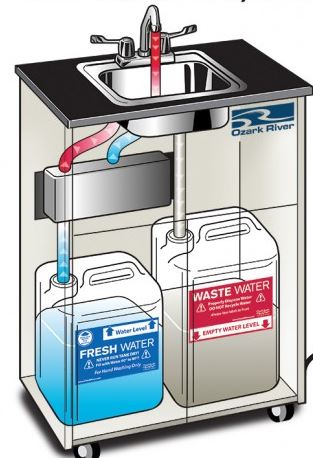
Portable outdoor sinks provide complete functionality without any permanent plumbing connections. These all-in-one units are popular in food service, outdoor events, and temporary work sites—but newer models have design aesthetics suitable for residential outdoor kitchens.
How it works:
- Fresh water storage tank (5-10 gallons typical)
- Built-in electric tankless water heater
- Integrated wastewater collection tank
- Standard sink and faucet
- Runs on standard 110V outlet
What you get:
- Hot and cold running water
- No plumbing installation required
- Completely portable—move it anywhere
- No winterization issues—just drain and store
Real cost: $400-$1,500 depending on capacity and features
Best for:
- Rental properties
- Temporary outdoor kitchens
- RV-style outdoor cooking setups
- Food trucks and catering operations
- Situations where permanent plumbing isn’t feasible
Top-rated portable sink options:
- MONSAM Portable Sink (popular for outdoor events, clean design)
- Ozark River Portable Sink Station (commercial-grade, very durable)
- Portable Sink Depot models (range of sizes and price points)
Maintenance requirements:
- Fill fresh water tank as needed (easy access)
- Empty wastewater tank regularly
- Clean both tanks monthly to prevent bacteria buildup
- Descale heater element annually
Limitations:
- Limited water capacity (need to refill fresh tank, empty waste tank)
- Takes up more space than a standard sink
- Requires electrical outlet
- Not as “built-in” looking as permanent installations
This option makes particular sense if you’re testing out outdoor cooking before committing to a full outdoor kitchen build, or if you’re in a temporary housing situation.
Outdoor Sink Drainage: Where Does the Water Go?
Once you’ve solved the water supply question, you need to address drainage. Unlike supply options where you have flexibility, drainage choices are largely dictated by local codes and your property setup.
Option 1: Connect to Household Sewer System
How it works: Similar to tapping into supply lines, you can connect your outdoor sink drain to existing household drain lines if you’re close to an exterior wall.
Requirements:
- Proper slope (1/4 inch per foot minimum)
- Vent stack for proper drainage
- P-trap to prevent sewer gas
- Code compliance and permits
Cost: $600-$2,000 typically included when tapping into supply lines
Best for:
- Outdoor sinks near the house
- When you’re already opening walls for supply lines
- Situations where you’ll dispose of food waste (needs sewer connection)
Critical note: You cannot drain food waste into French drains, dry wells, or bucket systems. If you’ll be rinsing dishes with food particles or disposing of cooking waste, sewer connection is required by code.
Option 2: French Drain or Dry Well (Gray Water Only)
How it works: Drain pipe from sink leads to a gravel-filled trench or underground dry well where gray water (soap and water, no food particles) slowly percolates into the soil.
What’s involved:
- Dig trench or well away from house foundation
- Install perforated drain pipe
- Fill with gravel to allow water absorption
- Cover and disguise in landscape
Cost: $200-$800 DIY, $500-$1,500 professionally installed
Best for:
- Hand washing and vegetable rinsing only
- Rural properties with good soil drainage
- Situations where sewer connection is impractical
Not suitable for:
- Dish washing with food particles
- Areas with clay soil or poor drainage
- Properties with high water tables
- Locations within 10 feet of house foundation
Code compliance: Check local regulations—some areas prohibit gray water discharge, others have specific requirements for distance from property lines, wells, and septic systems.
Option 3: Septic System Connection
How it works: Outdoor sink drainpipe connects directly to your existing septic system inlet, same as household drains.
Requirements:
- Proper slope to septic tank
- Distance considerations (don’t overload septic capacity)
- Professional installation recommended
Cost: $800-$2,500 depending on distance to septic tank
Best for:
- Properties already on septic systems
- When you need to handle food waste
- Rural properties where sewer connection isn’t available
Advantage over other options: Can handle food waste, grease, and full kitchen use—not limited to gray water only.
Option 4: Bucket Collection System
How it works: Sink drains directly into a 5-7 gallon bucket hidden inside the sink cabinet. You empty the bucket manually into your garden or indoor drain when full.
What you need:
- 5-7 gallon bucket with lid
- Drain assembly that extends into bucket
- Easy access panel in cabinet for bucket removal
Cost: Under $50
Best for:
- Light use (hand washing, filling pots)
- Gray water only
- Situations where other drainage options aren’t feasible
- Very budget-conscious installations
Limitations:
- Requires frequent emptying (daily if used regularly)
- Not suitable for heavy cooking and dish washing
- Water with food particles will create odor issues
- Labor-intensive maintenance
Make it work better:
- Use a bucket with a tight-sealing lid to prevent odors
- Add a charcoal filter to cabinet for odor control
- Create a garden irrigation system to use captured gray water productively
- Keep a backup bucket so you can swap when one fills
This is genuinely the simplest, cheapest solution—and for occasional outdoor cooks who primarily use the sink for hand washing and vegetable prep, it works perfectly fine. Don’t let the “bucket” aspect discourage you if your needs are minimal.
The Winterization Problem Nobody Plans For
Here’s the expensive mistake most outdoor kitchen owners make: they install a beautiful sink with permanent plumbing, use it all summer, then forget to winterize before the first freeze. One hard frost later, they’re facing burst pipes, cracked faucets, and $500-$1,500 in repairs.
Which Systems Need Winterization?
MUST winterize (freeze damage likely):
- Any system with permanent water lines
- Garden hose connections (hose itself must be stored)
- Tankless water heaters
- Outdoor faucets and fixtures
Minimal winterization needed:
- Portable sink systems (just drain and store indoors)
- Bucket drainage (nothing to freeze)
Proper Winterization Checklist
6 weeks before first freeze:
- Shut off water supply
- Close indoor shutoff valve if tapped into house plumbing
- Disconnect and store garden hoses
- Turn off outdoor spigot at interior valve
- Drain all water lines
- Open outdoor faucet to release pressure
- Open lowest drain valve to empty lines completely
- Blow out remaining water with compressed air (optional but recommended)
- Protect the faucet
- Remove aerator and store indoors
- Apply faucet cover or insulated bag
- Leave faucet in open position to prevent trapped water
- Drain tankless water heater
- Follow manufacturer’s winterization instructions
- Some models have drain plugs, others need to be completely removed
- Failure to drain heaters can result in cracked heat exchangers
- Protect against pests
- Stuff drain opening with steel wool or copper mesh
- Prevents mice, insects, and debris from entering during winter
- Remove in spring before first use
- Cover the sink
- Use hard sink cover or weatherproof fabric cover
- Protects finish from ice, sleet, and debris
- See our complete guide: Outdoor Sink Covers
YouTube Tutorial: [Search for and embed: “winterize outdoor sink” or “winterize outdoor plumbing” high-quality video]
Spring Start-Up Checklist
- Remove drain plugs and pest barriers
- Close all drain valves
- Slowly turn on water supply
- Check all connections for leaks
- Flush system for 2-3 minutes
- Check faucet operation and water pressure
- Inspect for any freeze damage
One freeze can undo your entire investment. If you live in a climate with freezing temperatures, winterization isn’t optional—it’s essential maintenance that should be scheduled on your calendar every fall.
Cost Comparison: Which System Fits Your Budget?
Here’s what you’ll actually spend for complete hot and cold water functionality:
Garden Hose + Tankless Heater:
- Installation: $400-$1,000
- DIY-friendly: Yes
- Annual maintenance: Minimal
- Best value for: Seasonal use, budget-conscious builds
Tap Into House Plumbing:
- Installation: $1,500-$3,500
- DIY-friendly: No (requires licensed plumber)
- Annual maintenance: Winterization only
- Best value for: Year-round use, permanent installations
Sprinkler System Tap:
- Installation: $600-$1,500
- DIY-friendly: Moderate (code compliance tricky)
- Annual maintenance: Minimal
- Best value for: Mid-distance locations, existing irrigation
Portable Self-Contained:
- Purchase: $400-$1,500
- Installation: None
- Annual maintenance: Tank cleaning
- Best value for: Renters, temporary setups, flexibility
Add for drainage:
- Sewer connection: +$600-$2,000
- French drain: +$200-$800
- Bucket system: +$50
The hidden cost everyone forgets: Winterization damage from skipping this step can cost $500-$1,500 in a single freeze event. Factor annual winterization into your decision-making.
Which Solution Is Right for Your Outdoor Kitchen?
Choose based on your actual cooking patterns, not aspirational ones:
Garden Hose System if:
- You cook outdoors 1-2 times per week during warm months
- Your sink is primarily for hand washing and vegetable prep
- Budget is a primary concern
- You’re comfortable with seasonal setup/winterization
Permanent House Plumbing if:
- You cook outdoors 3+ times per week
- You regularly wash dishes and cookware outside
- Your outdoor kitchen is a primary cooking space
- Resale value matters
- Distance to house plumbing is under 15 feet
Sprinkler Tap if:
- Your outdoor kitchen is 20+ feet from house
- You have existing irrigation infrastructure
- You don’t mind cold water (or will add tankless heater)
- Mid-range budget
Portable System if:
- You’re renting
- You want maximum flexibility
- You cook outdoors occasionally
- You might move or redesign the space
- You want zero installation hassle
The honest truth: Most outdoor cooks who start with garden hose setups find them perfectly adequate for years before (if ever) upgrading to permanent plumbing. Start simple, and upgrade if your cooking patterns justify it. You can always add permanent plumbing later—you can’t easily remove it once it’s installed.
Related Resources
Planning your outdoor kitchen sink? See our other guides:
How to Choose the Perfect Outdoor Sink – Size, style, and features
Is An Outdoor Kitchen Sink Worth It? – ROI calculator and decision framework
Outdoor Sink Covers – Protection and winterization
Outdoor Stainless Steel Sink – Material selection guide